Vodcast Film Technology
Four short vodcasts on film technique and film production.
Four videos, two minutes each, all self-made
Sometimes the most interesting projects are the ones where you're simply thrown into the deep end. In the winter semester of 2021/22, that was for me the course Audiovisual Media 2: Film Technique + Film Production at TH Mittelhessen, and the assignment initially sounded simple: four short teaching videos, no more than two minutes per piece. Done.
Spoiler: it wasn't that simple after all.
The four topics spanned the world of film technique: reflectors, transistors, microphone placement on set, and why you can't really dim diodes. Since it was a solo production, I was responsible for everything: voice acting, audio editing, video editing, and CGI animations. I used Ardour as the DAW, Kdenlive for the video editing, and Blender for the animations.
What was the hardest lesson along the way? Not producing, but cutting things.
Vodcast 1: Reflectors, more light without plugging anything in
The first topic starts with something that sounds understated but makes a huge difference in practice: reflectors. Natural light is great, but it's stubborn, the sun can't be rearranged, and wiring up large outdoor lights is often simply impossible. Reflectors are passive helpers that steer the available light precisely, completely without a power outlet.

In the video, I demonstrate it with a sample scene: a model in diffuse light where the face is barely recognizable. A spotlight as a highlight separates the subject from the background, but only the reflector brings soft fill light into the face and makes it truly readable. One adjustment, a visible difference. Switching to a golden reflector goes one step further: the scene instantly feels warmer, even though nothing about the actual light source has changed.
If you look closely, you'll notice: the entire scene was created in the computer, on purpose. Because light follows the same rules whether you're on a real set or in Blender. What's true in reality is just as true virtually, and vice versa.
Vodcast 2: Transistors, the tiny component with big impact
After reflectors, the second vodcast gets a bit more technical: transistors, and the question of what tiny components have to do with film technique.

In simplified terms, a transistor is an electrically controllable resistor. It consists of three doped semiconductor layers: collector (C), base (B), and emitter (E). C and E are negatively doped and therefore conduct poorly, while B is positively doped. The idea behind it is this: if no current flows through the base, the connection between C and E remains blocked. If even a small current flows into B, the channel opens. A switch on an electron level.
The link to film technique? Transistors are in every display, HD, OLED, you name it. In digital technology, a transistor clearly distinguishes between “active” and “inactive.” In analog signals, transistors combined with resistors produce continuous levels of brightness. Depending on the display type, that adds up to a few hundred, or even tens of thousands, of transistors. No transistor, no image, and therefore no film.
Vodcast 3: Microphone placement on set, the invisible job
Sound is just as essential in film as the picture, and it's much harder to capture than you'd think.
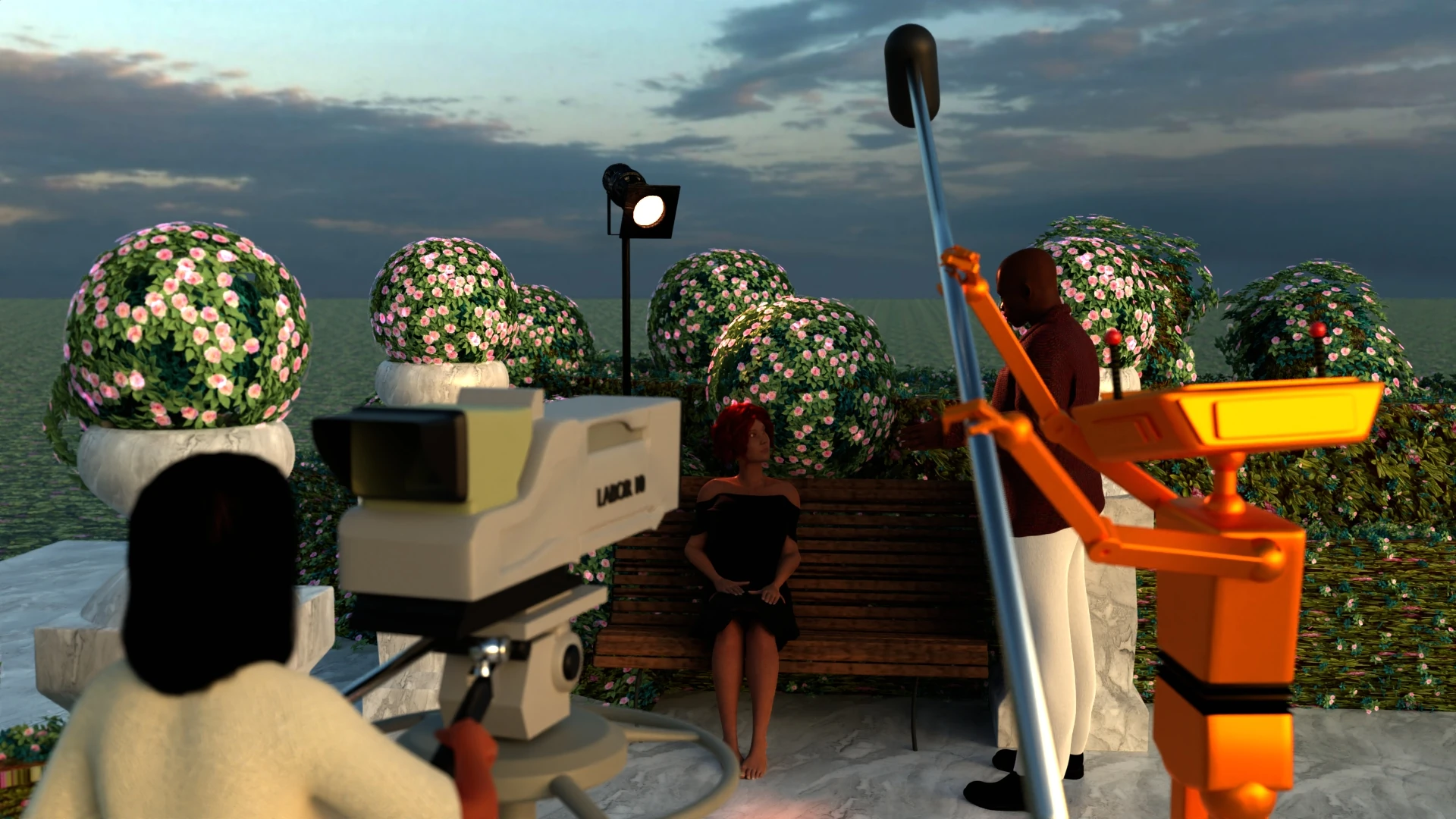
The key term is original sound (O-Ton): the original dialogue recorded directly on set. Re-dubbing in the studio usually doesn't work, because emphasis and facial expressions need to match the real moment. But there's a catch: microphone stands get in the way of the image, lavalier mics crackle through clothing, and headsets often don't hold up. The solution is the boom operator, a person who holds a microphone on a boom pole that can be up to six meters long, recording from just outside the frame.
Sounds simple, isn't it. The sound operator has to keep track of the camera framing while also considering lighting, reflective surfaces, and maintaining eye contact with the camera, often in an uncomfortable stance, for minutes on end. If they do the job right, they're simply not present in the finished film. That's the standard.
Vodcast 4: Why you can't simply dim diodes
On set, there are two kinds of light sources: thermal emitters that can be dimmed easily by adjusting the voltage, and cold emitters like LEDs that you can't. An LED is a semiconductor with built-in electronics: too little voltage and it won't respond at all; too much and it burns out. On top of that, each LED type has a fixed forward voltage and a color determined by its material. So “dimming” in the classic sense simply isn't built in.
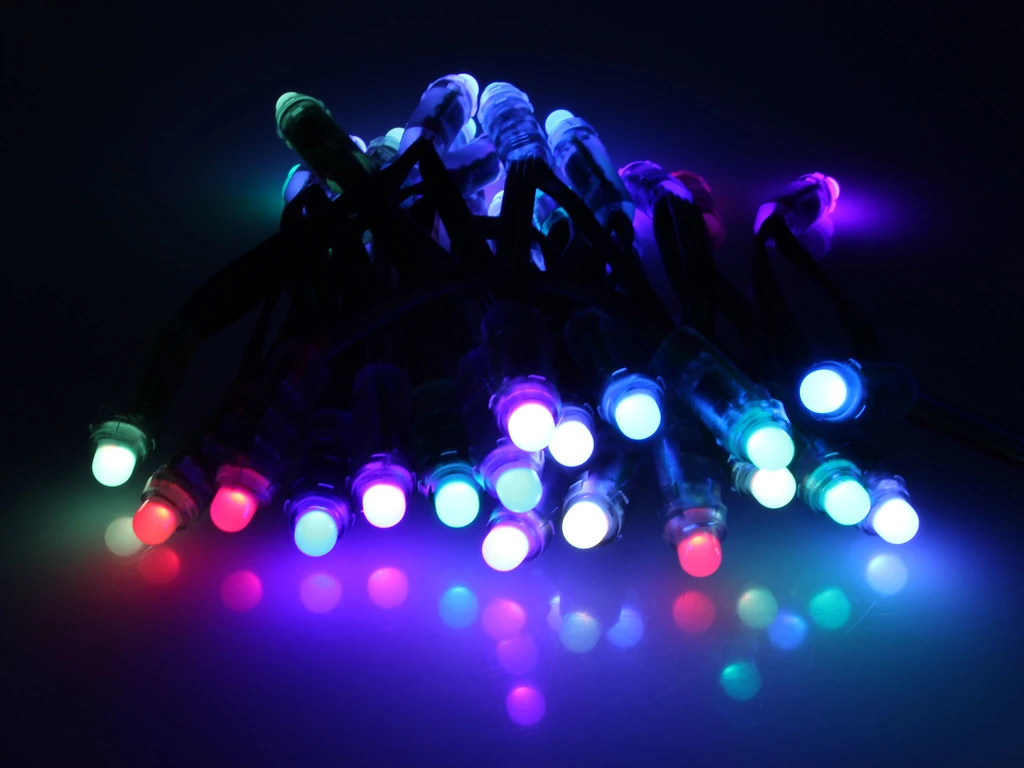
Even so, there are two ways to control brightness. The 0–10V light control switches between multiple LEDs, in steps, smoothly and flicker-free. Pulse-width modulation (PWM) turns the LED on and off so fast that the eye only perceives dimmed light. The catch: if the camera shutter operates at a similar frequency, the footage flickers, or can even end up completely dark.
If you're using LEDs on set, the safe choice is to go with 0–10V control.