The biggest problem with the Linux desktop: outdated recommendations
The Linux desktop often fails not because of a lack of progress, but because of outdated recommendations. Beginners encounter old baggage and mistake it for the current state.
When the weaknesses of the Linux desktop are discussed, attention usually turns to the technology: drivers, Wayland, audio, package formats, or individual distributions. But one of the bigger problems isn't only in the system itself, it's also in the way new users are introduced to Linux.
Too many recommendations still follow thought patterns from an earlier phase of the Linux desktop. Old experiences are passed on as if they were still generally valid. This creates a picture of Linux that often only partially matches today's reality. That rarely happens intentionally. The consequences are still noticeable, though: newcomers end up on setups that preserve earlier weaknesses, and then assume that exact experience reflects the current state of the Linux desktop.
In this article, I focus more on the structural problem of the Linux community, and less on the various release models in detail. I've already written about that here.
Outdated advice
Many judgments that still stubbornly persist today don't come from the present. They originate in older software versions. Then Wayland is considered unfinished, PipeWire unreliable, Linux on new hardware problematic, and modern package formats unnecessarily complicated.
These assessments don't come out of nowhere. They often had a real basis at one point. The problem arises when an observation that was once accurate is turned into a general, lasting truth.
If someone has been using a conservative distribution for years, they often describe primarily its current state not automatically the state of the Linux desktop as a whole. Exactly this distinction gets lost in many discussions.

Techlore - Pick your Level
Wayland judgments
When people say today that Wayland still isn't everyday-ready, that judgment often comes from environments where older or long-preserved Wayland versions are actually in use. The problem isn't that this experience is fabricated, but that it's frequently passed on as a general statement about today's desktop.
This is exactly where experience turns into an outdated narrative. Newcomers often end up with recommendations that don't reflect the current state of modern Linux desktops, but instead preserve the caution of past software versions.
New hardware
A similar pattern plays out with new hardware. Anyone who combines current devices with an older or intentionally sluggish system base is likely to run into exactly the problems that are later blamed on Linux as a whole: incomplete driver support, weaker power management, or a desktop that seems unfinished.
That doesn't automatically mean that Linux has poor support for modern hardware. More often, it just means that beginners start from a foundation that simply wasn't chosen to fit current devices. So again, a setup problem that could be avoided gets turned into a general desktop claim. The same applies to peripherals bought later: what still causes issues on an older base would often be supported by a rolling-release system by now quietly and without incident.
PipeWire's reputation
Audio follows the same pattern again. PipeWire once had real weaknesses, and those early problems still shape many judgments to this day. But when such experiences come from older or preserved system states and are nonetheless passed along as a general description of the present, the result is again a distorted impression.
It isn't the current desktop state that's speaking rather, it's the echo of a transitional phase. And again, the consequences hit newcomers most of all, who then treat these leftover issues as the normal state of Linux.
Fair point: PipeWire's public reputation has improved significantly over the last few years. Some voices, however, persist stubbornly.
Flatpak criticism
Flatpak shows the same pattern: older experiences get turned into sweeping judgments. The criticism often sounds familiar: too big, too many runtimes, unnecessary overhead, too much isolation. Some of it isn't entirely groundless. The problem starts when individual downsides are turned into a general verdict against the entire model.
Because many of the frustrations users experience with Flatpak don't come from Flatpak itself alone, but from its interaction with older desktop components, portals, or conservative system bases. A local integration problem quickly becomes an overall judgment. This is especially skewed for beginners, because one of the models that often improves software availability and maintainability on the desktop is reflexively treated as a root problem instead.
Tech influencers
This problem is particularly visible with tech influencers. Many of them use Linux in exactly the distributions and with the recommendations that have been passed on for years as safe default answers. In doing so, they don't just adopt a system, they often take on its legacy issues as well.
There's also the logic of the format itself: a stable everyday experience sells worse than a visible failure. Provocative titles, clicky thumbnails, and a dramaturgy of friction favor content where Linux becomes especially worth telling when something goes wrong. Whether that intensification is consciously sought or simply results from setups that are predictably ill-suited is almost beside the point. What matters is the effect: it's not today's desktop state that shapes perception, but the friction of outdated entry paths.

Linus Tech Tips - Linux is easy
Modern interface
This is especially misleading with distributions that look modern, but are built on an older base. For beginners, they appear up to date, feel friendly and accessible, and give the impression that they offer a current Linux experience.
Then, if the exact same old pitfalls are waiting under the hood,the impression becomes distorted: modern in appearance, outdated in behavior. This isn't an accusation against any single distribution, but a fundamental perception problem. Design, user-friendliness, and currency aren't the same thing, but in recommendations they're often treated as if they were.
Rolling != Arch
A central thinking error in many desktop debates is equating rolling releases with Arch Linux. This turns an update model into a specific cliche right away: complicated, fragile, and only suitable for tinkerers.
In this view, Arch is just one particular implementation of the model. A rolling release initially only means that software is updated continuously. How well this works on the desktop depends on the specific care, testing, and system architecture. So if someone immediately equates every rolling-based recommendation with Arch, they're confusing a principle with one very specific variant, and that often steers beginners unnecessarily toward outdated release models.
Brodie Robertson - Common Ways Arch Linux & Rolling Releases Break
Immutable rejection
Rejecting immutable distributions often says less about their actual weaknesses than it does about the habits many Linux users still have when they think about the desktop. For many, a system only counts as "real" once you can work directly in the base at any time, mix packages, and change the underlying foundation however you like. But on the modern desktop, this pattern is often more baggage than strength.
Because immutable systems solve many everyday problems precisely by keeping the base small, clear, and controllable. Snapshots, rollbacks, health checks, Flatpak as the default, and container workflows like Distrobox aren't artificial restrictions, they're tools for organizing stability, security, and maintainability more cleanly. The fact that these systems are still so often dismissed reflexively mainly shows how strongly older usage patterns shape perceptions of the desktop.
Immutable point releases
With immutable distributions, the question gets especially sharp: if applications already arrive via Flatpak, and additional tools run through Distrobox or containers, why should the base follow a slow, old-fashioned point-release rhythm? In this model, many classic arguments for a conservative underlying layer lose much of their weight, while their familiar downsides remain: older drivers, slower hardware support, and a desktop stack that's more likely to fall behind what's possible.
That means giving away part of the immutable approach's real strength. Because if applications are already decoupled and the host is intentionally kept minimal, then on the desktop there's a lot to be said for not artificially locking the base into old release cycles either.
Point-release risk
The problem with point releases on the desktop isn't only that their base visibly ages over time. What's more difficult is that these systems later have to be carried into a new state through a version jump. And this transition rarely hits a clean baseline, instead, it usually affects a desktop that's been individually customized over years, with applications, additional sources, libraries, and manual tweaks all landing directly in the base system. Exactly this is what makes upgrades less simple for beginners, not more: they often become unpredictable.
This is also where it becomes clear why modern immutable systems deliberately keep their base small. The less permanently ends up in the host system, the more controllable its state remains. What is often considered normal package maintenance on classical distributions quickly turns on the desktop into a hard-to-predict mix of system base and user history. In many cases, rolling releases, and especially immutables, get around this problem more elegantly, because they don't require big version leaps; instead, they continuously carry the system forward.
Wrong entry paths
The key issue isn't that individual users intentionally tell people the wrong things. Most speak honestly from their own experience. The problem is structural: old, conservative desktop experiences are too rarely placed in their proper time and technical context, and are therefore passed on as general guidance. As a result, newcomers repeatedly end up on systems that unnecessarily carry forward earlier problems, experience precisely that friction as their first impression, and then assume it's representative. In this way, the Linux community reproduces its own narrative: from old experiences come default recommendations, from default recommendations come predictable disappointments, and from those disappointments, the impression arises again that Linux is still not quite there on the desktop.
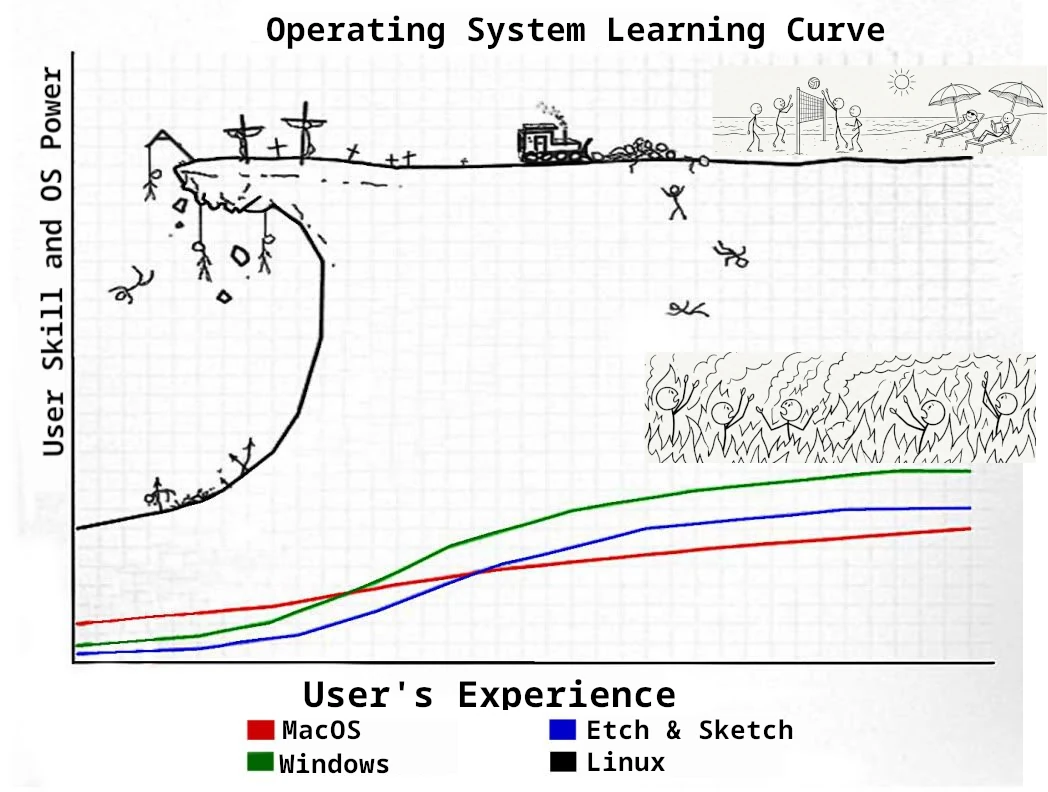
programmerhumor.io - Operating System Learning Curve
Linux websites
Not only forums and individual people perpetuate this image. Many Linux websites do it too, often entirely without malicious intent. They frequently write beginner recommendations, distribution comparisons, and desktop advice from a perspective that still treats conservative systems as a reasonable default, while presenting modern desktop models more as a special case or a risk.
The problem isn't so much any single incorrect statement as the sum of habits. When the same old recommendations are repeatedly confirmed editorially, they start to look like tried-and-true guidance, even though, on the desktop, they often secure outdated conditions rather than reflecting current possibilities. In this way, the narrative becomes entrenched not just socially, but also editorially.
These are not beginner distros
If you take the desktop seriously, then classic point-release systems no longer belong among the most obvious standard recommendations for beginners. For me, that includes primarily Ubuntu, Debian, openSUSE Leap, Zorin OS, Linux Mint, and comparable systems whose strength lies mainly in preserved software versions. Even Fedora and variants built on top of it, like Nobara or Bazzite, aren't outside the problem for me: they're more modern than classic point releases, but they still get stuck in a model where periodic version changes are structurally part of the deal.
The point isn't that these distributions are bad in every scenario. The point is that, on the desktop, they often carry forward more old friction than they actually take away from beginners. And that's exactly why I don't consider them the most sensible standard path.
My recommendations
If I had to recommend something for beginners today, I'd rather point to systems like Kalpa Desktop or Aeon Desktop: immutable and rolling-minded desktops without version jumps, where applications and the system base are cleanly separated, and where many classic sources of error simply don't end up deeply inside the host.
If someone is more experienced and intentionally wants a classic, non-immutable system, then in my view openSUSE Tumbleweed or CachyOS are a better fit than the usual point-release standards. Not because these systems are perfect, but because their underlying model for today's desktop is usually more coherent: no big version jumps, no artificially aged base, and a much lower risk that old release logic will be misunderstood as "Linux reality."
What needs to change
If Linux is going to win people over on the desktop, it doesn't just need better technology, it needs a more honest recommendation culture. As long as beginners reflexively get pointed toward point releases, old LTS bases, and outdated desktop models, they experience, far too often, exactly the problems that then get retold as "Linux reality."
This isn't neutral caution. It's the systematic passing on of outdated desktop experiences as current guidance. And that's exactly why a narrative persists that often no longer does justice to the modern Linux desktop.
We all pay the price for that, veterans, beginners, and the Linux desktop.